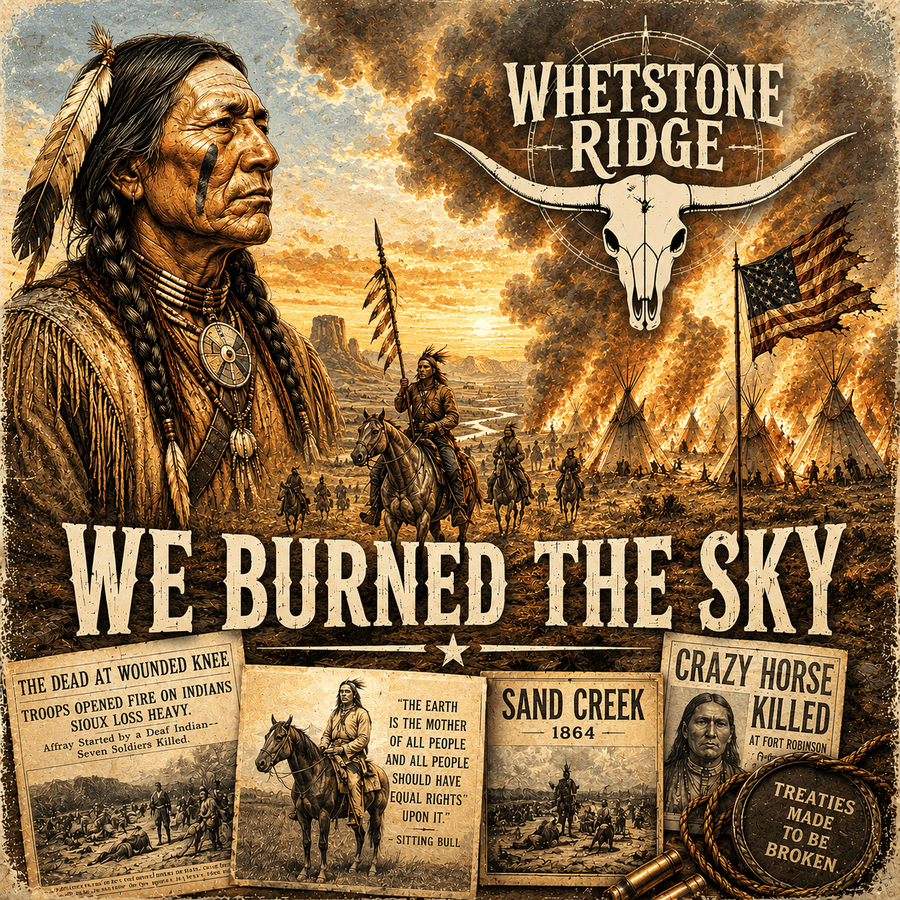
We Burned The Sky is the most serious song we have ever put our name on, and it did not come easily. Cole had been reading about the Plains wars and the treaties that were broken one after another, and he kept running into the same pattern of language: progress, law, schooling, divine right. He wrote the chorus first, as a kind of translation of those words into what they meant on the ground. Every line of it is a sentence that sounds respectable until you say it out loud.
The band debated for a long time whether we had any business writing it. In the end we agreed on two rules. First, no costumes, no borrowed voices, no pretending to speak for anyone. The narrator is a white man from this country looking at what his people did, which is the only honest position for us. Second, no glory. The song does not celebrate war; it lingers on the names because the names are what got erased. Jack, who rarely speaks in sessions, told us he wanted the guitars to sound like smoke.
Hank pushed for a heavier, angrier arrangement, and he was right. There is no place in this song for a gentle banjo. The drums come in like a door being kicked, the bass stays low and relentless, and the solo is short and bitter. When we finished the last take Cole sat on the floor of the studio and did not say anything for a long time. Then he asked us not to explain the song in interviews more than we had to. So this is as much as we'll say. Listen to it, then go read a book.
In Their Words
Five Men, One Song
We sat the band down after the last take and asked each of them about this one. This is what came out.
Why did you write this one?
“Because I was ashamed that I didn't know more. I thought I knew the story. Then I read the real one. A song can't fix any of it. But it can say the plain thing out loud, which is a start.”
How do you play a song like this?
“Honestly. No tricks. A heavy riff, a short solo, a lot of space for the words. I didn't want to decorate it. Some subjects don't need ornament.”
The drums feel angrier than usual.
“They should. This is a song about people being told it was for their own good. I've been hit by someone who said it was for my own good. The memory helps.”
What do you want listeners to feel?
“Uncomfortable, then curious. If someone finishes the song and goes to look up Sand Creek or Wounded Knee, we did our job. The song is the doorway, not the room.”
Any thoughts on the bass line?
“It never rests. That was deliberate. History doesn't take breaks, and I didn't think I should either.”
The Words
Lyrics
They rode into the valley with their flags and their God
Drew lines on a map over Lakota sod
Called it manifest, called it divine right
Sitting Bull knew different on that June night
Little Bighorn ran red in the summer heat
Custer got exactly what he went to meet
The papers called it massacre, called it a shame
When white men lose it always needs a name
But ask the Lakota what massacre means
They'll tell you Sand Creek, tell you Wounded Knee
We burned the sky and we called it progress
We broke the treaties and we called it law
We took the children and we called it schooling
The ugliest thing you ever saw
We burned the sky
Crazy Horse never bowed and never broke
Died on a bayonet surrounded by smoke
They feared a dead man so they hid where he lay
Some truths are too big to put away
Wounded Knee, December, three hundred gone
Frozen in the field by the break of dawn
Big Foot's people wrapped in government snow
History turned the page and tried not to know
But ask the Lakota what massacre means
They'll tell you Sand Creek, tell you Wounded Knee
We burned the sky and we called it progress
We broke the treaties and we called it law
We took the children and we called it schooling
The ugliest thing you ever saw
We burned the sky
Geronimo ran twenty years through the stone
The last free Apache fighting alone
When they caged him they thought they had won
You can't cage what the desert already done
We burned the sky and we called it progress
We broke the treaties and we called it law
We took the children and we called it schooling
The ugliest thing you ever saw
We burned the sky
We burned the sky and we called it progress
We broke the treaties and we called it law
We took the children and we called it schooling
The ugliest thing you ever saw
We burned the sky
Between the Lines
What the Lyrics Are Really Saying
We Burned The Sky is built like a charge sheet. Each verse names an event or a figure, and the chorus acts as the verdict. The first verse begins with arrival: they rode into the valley with their flags and their God, drew lines on a map over Lakota sod, and called it manifest, called it divine right. The key word is called. The entire song is about the distance between what things were named and what they were, and it begins by showing us how easily language can launder violence.
The second verse turns to Little Bighorn and a line that stings by design: the papers called it a massacre, a shame, but when white men lose it always needs a name. It is a pointed observation about whose deaths are remembered as atrocities. The pre-chorus then brings in the voice the history books were slow to include. Ask the Lakota what massacre means, and they will tell you Sand Creek, they will tell you Wounded Knee. The sentence turns the perspective around, and it makes the listener the one who is being instructed.
The chorus is the moral core, and it is one of the most direct things Cole has written. We burned the sky and we called it progress. We broke the treaties and we called it law. We took the children and we called it schooling. The ugliest thing you ever saw. Each line has the same structure: an act of violence followed by its euphemism. The final refrain, we burned the sky, is a statement of collective responsibility. It says we, not they.
The later verses honor those who resisted. Crazy Horse never bowed and never broke, and they feared a dead man so much they hid where he lay. At Wounded Knee, in December, hundreds were left frozen in the field while history turned the page and tried not to know. The bridge turns to Geronimo, who ran for years through the stone, and the song's last defiant image is the one that sticks: you cannot cage what the desert already done. It is an uncomfortable song and a necessary one, and it does not ask the listener for forgiveness. It asks them to remember.