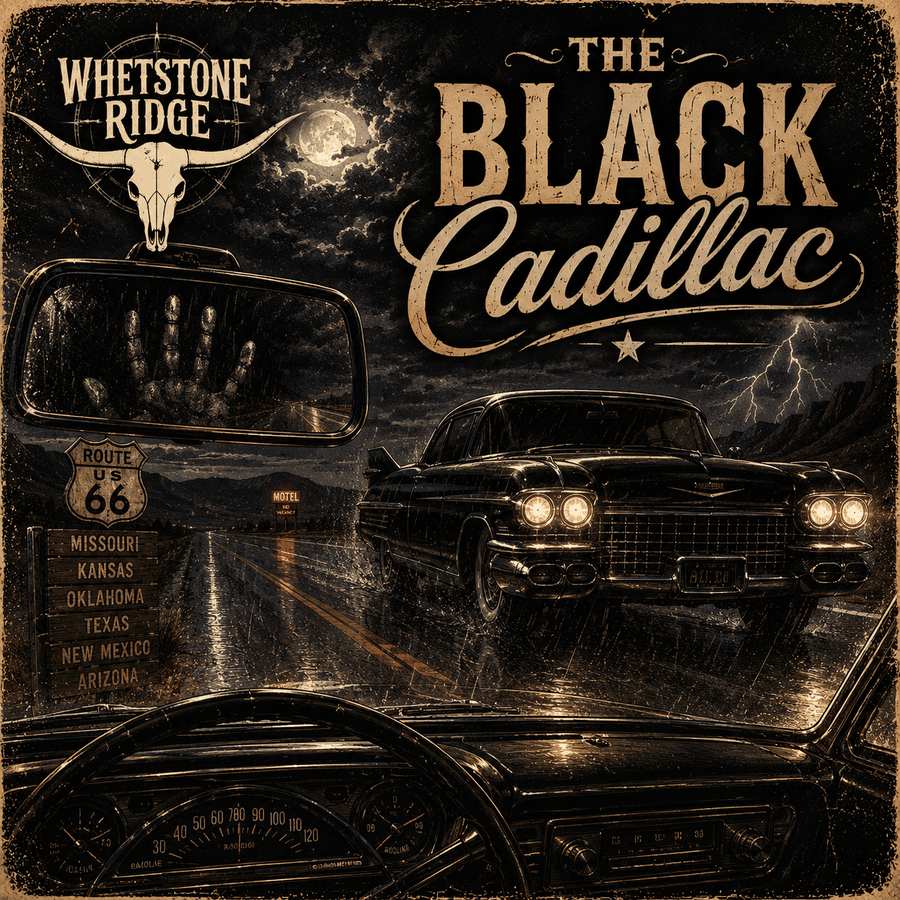
Every American road has a ghost car story, and Dean has been collecting them for years. Most of them are lies. A few are well told. The best one, according to him, came from a gas station attendant in Arkansas who swore that a black Cadillac with no driver had followed a customer for forty miles one night and then simply vanished at the county line. Dean wrote the story down on a napkin and passed it to Cole without a word. Cole read it twice and said, that's a song.
The first draft had the right fear and the wrong car. It mixed a modern dashboard with a ghost from 1954, and the whole thing felt like two movies stitched together. So we rewrote it. The narrator now drives an old V8 truck himself, which levels the field between the living and the dead and makes the chase feel like a duel between two relics. The setting settled on Route Sixty-Six through the Arkansas night, and suddenly the song had a world.
Jack built the main riff from a pair of low strings and a lot of dread. Hank locked into a hard, heavy shuffle that sounds like a V8 pulling a hill. When Cole came to the spoken outro, the handprint on the window from the inside, we asked him to say it as flat as a policeman reading a report. He did it in one take, and the studio went quiet. Nobody wanted to look in the mirror on the drive home.
In Their Words
Five Men, One Song
We sat the band down after the last take and asked each of them about this one. This is what came out.
Where did the story come from?
“From a gas station attendant who had no reason to lie to me. I've thought about his face for two years. He wasn't joking. He was just very tired and very sure.”
How do you write fear?
“With specifics. Don't write 'something scary.' Write 'two dead headlights with a hollow stare.' Nobody's scared of an abstraction. They're scared of a grille that looks like it's grinning.”
Tell us about that riff.
“Two low strings, a lot of tension, and a refusal to resolve. The riff is the car. It never fully arrives and it never fully leaves.”
Did you check your mirrors after tracking?
“For a week. I'm not ashamed. I put a sticker over the rear-view mirror and the sticker said 'not today.'”
The drums feel like an engine.
“They are an engine. A hungry one. I imagined the car chasing me, and I played like I was the one who had to outrun it. Then I tripped over a cymbal stand and the illusion died, but only for a moment.”
The Words
Lyrics
Route Sixty-Six, midnight rain
Old V8 engine running through the pain
Headlights cutting through the mountain pass
When something caught the corner of my glass
A big black Cadillac with no plates in sight
Riding my bumper through the Arkansas night
No engine roaring, no exhaust in air
Just two dead headlights with a hollow stare
Windows black as a coal mine shaft
Chrome grill grinning like the devil laughed
I floored it hard but it stayed right there
Like it wasn't driving - like it didn't care
The radio died and the needle dropped red
Running from something that should've been dead
No driver in the Cadillac, no driver in the black
Running down the highway and it ain't turning back
No driver in the Cadillac, no driver in the black
Better look out boy it's riding on your tail
No driver in the black
Static humming on the AM band
Something cold pressing on my hand
The county line was just a mile ahead
But the black car edged up to my door instead
Two yellow eyes where the driver ought to be
And whatever looked back wasn't looking at the road - it was looking at me
A ghost on chrome from nineteen fifty-four
Died on this highway and came back for more
It doesn't need gas, it doesn't need a road
It just carries a dead man's unfinished load
Some debts don't clear when the body hits the ground
Some black Cadillacs just keep coming around
No driver in the Cadillac, no driver in the black
Running down the highway and it ain't turning back
No driver in the Cadillac, no driver in the black
Better look out boy it's riding on your tail
No driver in the black
I crossed the county line at four in the morning.
Checked the mirror.
Empty road.
But there was a handprint on my window.
From the inside.
No driver in the black.
Between the Lines
What the Lyrics Are Really Saying
The Black Cadillac is a ghost story told in the language of highway noir. The first verse establishes everything you need in six lines: Route Sixty-Six, midnight rain, an old V8 running through the pain, headlights cutting through a mountain pass. Something catches the corner of the narrator's glass, and it is a big black Cadillac with no plates in sight, riding his bumper through the Arkansas night. The details are chosen like cuts in a film: the road, the weather, the machine, the follower.
The second verse turns the dread up by subtraction. No engine roaring, no exhaust in the air, just two dead headlights with a hollow stare. The windows are black as a coal mine shaft and the chrome grille is grinning like the devil laughed. The narrator floors it, but the car stays right there, like it was not driving and did not care. The horror of the song comes from the sense of indifference: this thing does not hunt him out of malice, it simply follows, as if it has always been following.
The chorus is a taunt and a warning at once. No driver in the Cadillac, no driver in the black. It runs down the highway and it ain't turning back. The refrain is repeated until it becomes a sort of curse. The third verse delivers the scariest image of all: two yellow eyes where the driver ought to be, and whatever looked back was not looking at the road, it was looking at him. The fear shifts from being chased to being seen.
The bridge gives the ghost a history. A ghost on chrome from 1954 died on this highway and came back for more. It does not need gas and does not need a road; it just carries a dead man's unfinished load. Some debts do not clear when the body hits the ground. The spoken outro lands the blow: he crosses the county line at four in the morning, checks the mirror, and finds an empty road. But there is a handprint on his window. From the inside. The song ends on that detail, and it is a perfect place to leave you.