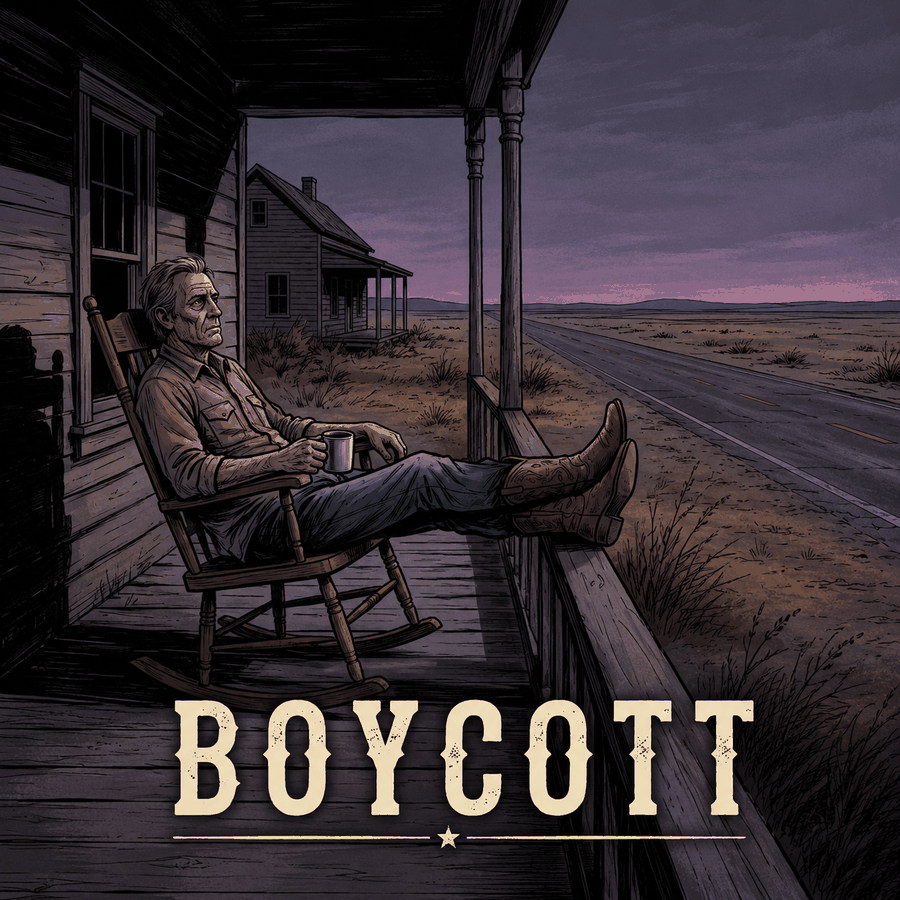
Boycott is the odd one out on purpose. Cole had been reading late at night, which is dangerous, and kept running into the idea that the loudest protest in the world is sometimes a person who simply stops showing up. No march, no sign, no speech. He started imagining a man who withdraws from everything one small habit at a time, and who discovers that the world does not even blink. The song came out of that thought, sad and funny in equal parts.
We knew early that it should not have a chorus. A chorus is an invitation to sing along, and this is a song about not being invited. So the structure is a string of verses that stack up like unopened mail. Jack plays almost nothing, one fingerpicked line and a cello we borrowed from a friend who plays at funerals and thought that was a compliment. Dean found a single low note and refused to move off it, and the song is better for his stubbornness.
The studio was quiet for a full minute after the last whispered line. Then Hank cleared his throat and said, very softly for him, that he had not realized we were allowed to make songs like that. We were. It is slower than anything else we have done, and it is the song people tell us they listen to alone, with the lights off, usually twice.
In Their Words
Five Men, One Song
We sat the band down after the last take and asked each of them about this one. This is what came out.
Why no chorus?
“Because the man in the song doesn't have a crowd. A chorus needs people. He's got a porch and a cup of coffee. I trusted the verses to carry it, and I trusted you to lean in.”
You hold one note for a long time here.
“Patience is the whole instrument. I did three years of waiting before I ever found the bass, so a held note is easy. It's like being in a room with a thought you can't leave.”
What did you play?
“As little as possible. A fingerpicked line, a few notes of space. Quiet is harder than loud. Anyone can set a Marshall on fire. Try making a silence interesting.”
Is Boycott a political song?
“It's a personal song that happens to stand in a political room. The man never says who he's mad at. He's just done. Everyone hears their own list. I like that nobody agrees on what he's boycotting.”
What did you do on this one? You don't seem to have any drums.
“Exactly. I sat there. I held a coffee. I contributed my silence, which for me is a rare and expensive gift. Please send thanks.”
The Words
Lyrics
I stopped buying what they were selling
Round about the fall of some forgotten year
Didn't make a sign, didn't tell a soul
Just left the cart beside the door and walked out clear
I stopped voting when the ballot felt like choosing
Between two doors that opened on the same damn wall
I stopped watching when the screen began returning
My own face back to me - distorted, small
I stopped eating at the table they were setting
Meat on the bone of something I couldn't name
I stopped singing the anthem at the ballgame
When the words sat in my mouth like borrowed shame
Nobody noticed when I pulled the curtain
Nobody sent a letter or a fine
The machine kept running without my contribution
Turns out the gears don't need this kind of mind
I boycott the noise but the noise don't hear me
I boycott the light but the light stays on
I boycott the war but the war keeps marching
I boycott the song but the song plays on
And on
And on
So I sit on the porch with a cup of something real
Watch the road that used to carry me away
The birds don't care about the price of silence
The grass don't know what side it's on today
Maybe this is what they wanted all along
The quiet ones to quietly disappear
Maybe boycott is just another word
For finally admitting no one hears
No one hears
No one hears
Between the Lines
What the Lyrics Are Really Saying
The title promises protest, but the song delivers something far stranger and more human. Boycott is a portrait of withdrawal, and it works because its narrator never raises his voice. He stopped buying what they were selling around the fall of some forgotten year. He made no sign and told no one. He just left the cart beside the door and walked out clear. The line has the soft finality of a man closing a gate behind him.
The verses that follow move through the small surrenders of modern life. He stops voting when the ballot feels like choosing between two doors in the same wall. He stops watching when the screen starts handing his own face back distorted and small. He stops eating at a table he did not set, and stops singing an anthem whose words sit in his mouth like borrowed shame. Each one is a tiny refusal, and together they build a quiet portrait of a person who has run out of agreement.
Then comes the cruelest turn. Nobody noticed. Nobody sent a letter or a fine, and the machine kept running without his contribution. The song's sharpest insight is that the system does not need your consent, only your absence, and that it will not even register that you are gone. The repeated verse where he boycotts the noise, the light, the war and the song, and each keeps going, is a gut punch. The anaphora builds a wall of things he cannot stop by leaving.
What is left is a porch, a cup of something real, and a road that used to carry him away. The birds do not care about the price of silence. The grass does not know what side it is on. The final verse offers a bleak possibility, that maybe this is exactly what they wanted, the quiet ones quietly disappearing. And then a whisper: no one hears. It is a haunting ending, and also an invitation. If a song can hear him, maybe he is not entirely alone.